

Bajaj Pulsar 125 Launched at Rs 92,900: What’s New

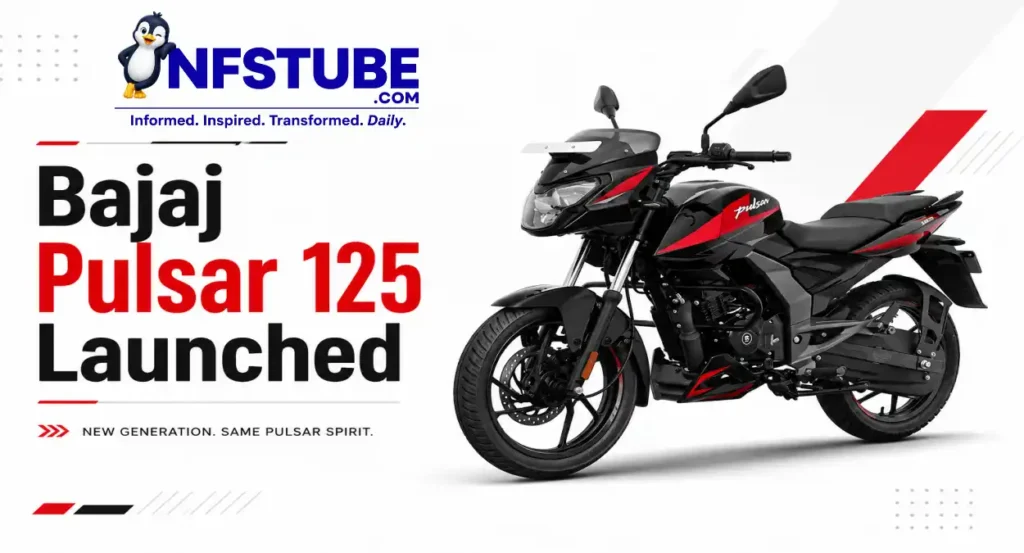


Bajaj Auto has launched the 2026 Pulsar 125 at Rs 92,900 in India, giving its long-running 125cc motorcycle a much bigger mechanical and technology update than a routine facelift. The new generation gets a revised engine and gearbox, a new diamond-type frame, monoshock suspension, Crawl Tech and a 5-inch TFT console on higher variants. The price is introductory and ex-showroom Delhi.
The new Pulsar 125 is part of the 25th anniversary celebrations of the Pulsar brand, which was introduced in India in 2001. Bajaj has retained the familiar Pulsar identity while changing much of what sits underneath it.
Bajaj Pulsar 125: Quick Highlights
| Detail | 2026 Bajaj Pulsar 125 |
|---|---|
| Starting price | Rs 92,900 |
| Top variant | Rs 1,04,318 |
| Engine | 124.58cc |
| Power | 12 PS |
| Torque | 11 Nm |
| Gearbox | 5-speed |
| Frame | Diamond-type |
| Rear suspension | Monoshock |
| Display | LCD / 5-inch TFT |
| Ride modes | Road, Rain, Sport |
| Navigation | Google Maps mirroring |
| Low-speed feature | Crawl Tech |
| Start-stop | ISG on higher variants |
Bajaj offers the new Pulsar 125 in four variants, with prices rising from Rs 92,900 to Rs 1,04,318 ex-showroom Delhi. Some specialist reports currently list the base price as Rs 92,990, but Bajaj’s own launch release states Rs 92,900, which is the figure used here.
This is a mechanical upgrade, not just a new look for Bajaj Pulsar 125
The biggest change is the new 124.58cc engine. Bajaj claims 12 PS at 8,000rpm and 11Nm at 6,000rpm, while the new gearbox is designed to improve tractive effort in the lower gears. Bajaj also says the improved power-to-weight ratio enables quicker 0-60km/h acceleration.
That lower-speed focus is important for the Pulsar 125 because its everyday job is likely to involve city traffic and frequent acceleration from low speeds. Instead of chasing a dramatic increase in headline performance, Bajaj has worked on the engine, gearing and low-speed response that riders use repeatedly in normal commuting.
Also Read: Honda Rebel 300 Launched in India at Rs 2.22 Lakh
The chassis has changed significantly
The new Bajaj Pulsar 125 now uses a diamond-type frame, with the engine acting as a stiffness member. Bajaj says the revised structure is intended to improve handling, ride stability and overall chassis behaviour.
The rear suspension has also moved to a nitrogen gas-charged monoshock, replacing the previous twin-shock arrangement. Bajaj says the new setup is aimed at providing sportier handling, better straight-line stability and greater composure while cornering.
For an everyday 125cc motorcycle, this is arguably more significant than the styling changes. The Pulsar 125 now has a substantially revised platform underneath the familiar design, which should make the new generation feel meaningfully different rather than simply newer.
The 5-inch TFT brings premium technology to the 125
Higher variants of the Bajaj Pulsar 125 get a 5-inch TFT console with Google Maps mirroring and navigation functions. The display can also show live call and message alerts, provide music controls and store documents such as the vehicle registration and insurance details.
The important point for buyers is that the TFT is not standard across the range. The entry version uses a coloured LCD display, while the mid and higher variants add the TFT and a substantially larger technology package.
That creates a clear split within the Bajaj Pulsar 125 range. A buyer who simply wants the new motorcycle and its mechanical upgrades can stay with the lower-priced version, while someone who values connected features can move higher up the range.
Also Read: BMW X1 LWB Launched at ₹49.90 Lakh: Price, Features and Details
Ride modes and Crawl Tech are the unusual additions
The new Bajaj Pulsar 125 gets three ride modes, called Road, Rain and Sport, on the higher variants. Bajaj describes them as a segment-first feature, while Crawl Tech is designed to provide greater control and convenience during low-speed traffic.
Crawl Tech is arguably the more relevant feature for an Indian commuter. In slow-moving traffic, reducing the amount of throttle and clutch management required can make the motorcycle easier to control. Its usefulness will ultimately depend on how naturally the system works in real-world conditions.
The higher variants also get ISG automatic start-stop technology, which Bajaj says can help improve fuel economy while contributing to smoother operation.
Four variants, and the price difference matters
The new Bajaj Pulsar 125 range starts with a single-seat LCD variant at Rs 92,900. The next version costs Rs 99,291 and adds the major technology upgrades, while the split-seat version costs Rs 1,00,288. The top Premium Split Seat variant is priced at Rs 1,04,318.
| Variant | Ex-showroom Delhi |
|---|---|
| Base Single Seat LCD | Rs 92,900 |
| STD Single Seat TFT | Rs 99,291 |
| STD Split Seat TFT | Rs 1,00,288 |
| Premium Split Seat TFT | Rs 1,04,318 |
The Rs 6,391 jump from the base version to the Rs 99,291 variant is the more important step in the range because this is where the TFT, ride modes, LED indicators, hazard lamps, ISG and other technology become available.
That makes the base model attractive for buyers focused on the motorcycle itself, while the mid-spec version looks more compelling for someone who actually wants the new technology rather than simply the lowest possible price.
Also Read: Poco M8x 5G Launched in India: Price, Specs and Features
What has really changed?
The 2026 Bajaj Pulsar 125 is best understood as a new-generation motorcycle wearing a familiar Pulsar identity. Bajaj has kept the muscular silhouette and recognisable design language, but underneath it has introduced a new engine and gearbox, revised frame, monoshock suspension and a much larger technology package.
That is also why the new model has attracted attention across the current 125cc segment. Rivals such as the TVS Raider 125 and Hero Glamour X have already pushed technology higher in this category, and the new Bajaj Pulsar 125 now responds with its own combination of connected features, ride modes and revised hardware.
Bajaj Pulsar 125 Launched- YouTube Video Suggestion
The NFSTUBE take
The Rs 92,900 starting price keeps the Bajaj Pulsar 125 below the Rs 1 lakh mark, but the more interesting version is arguably the one around Rs 99,000. For a relatively modest step up from the base model, buyers get most of the technology that makes this generation genuinely different.
Bajaj has therefore avoided making the new Pulsar 125 simply a more expensive version of the old motorcycle. It has rebuilt the mechanical package, added technology normally associated with more expensive bikes and still retained an accessible entry price. After 25 years, the Bajaj Pulsar 125 has not abandoned what made the name familiar. It has moved the formula forward without throwing it away.
Also Read: Jio Prime Relaunched at ₹300: Price Lock, Benefits and Eligibility
Disclaimer: This article is intended for informational purposes only. Prices & Specs may vary by location and are subject to change without prior notice. For queries or corrections, please reach out via our Contact Form. Also refer to our Disclaimers & Transparency.
For the latest Tech, Entertainment, Fitness, and Lifestyle updates, follow NFSTUBE on Instagram, Facebook, YouTube & X(twitter) for daily updates.
For Smart & Quick daily updates, join our official WhatsApp Channel